History of St. Lawrence Church in Vivodina, Croatia
St. Lawrence — A Brief Description
St. Lawrence (Sveti Lovro) was a third-century Roman deacon and martyr. He served under Pope Sixtus II and was entrusted with charitable work and the care of the Church's resources. He is remembered especially for his devotion to serving the poor and for remaining faithful during the persecution of Christians under Emperor Valerian. His feast day is celebrated on August 10.
For the people of Vivodina, St. Lawrence has a special place in local identity and tradition. The parish church in Vivodina bears his name, and the annual celebration of his feast, known locally as Lovrečevo, remains an important part of the community's religious heritage.
History of St. Lawrence Church in Vivodina
Vivodina is an historic settlement in the Ozalj area of present-day Karlovac County. The parish is documented as early as 1321. The earliest surviving references connect the medieval parish with a church dedicated to St. George. In the 1330s, the parish was again recorded, and a 1334 list of parishes in the Zagreb Diocese identifies the Vivodina parish and its St. George church.
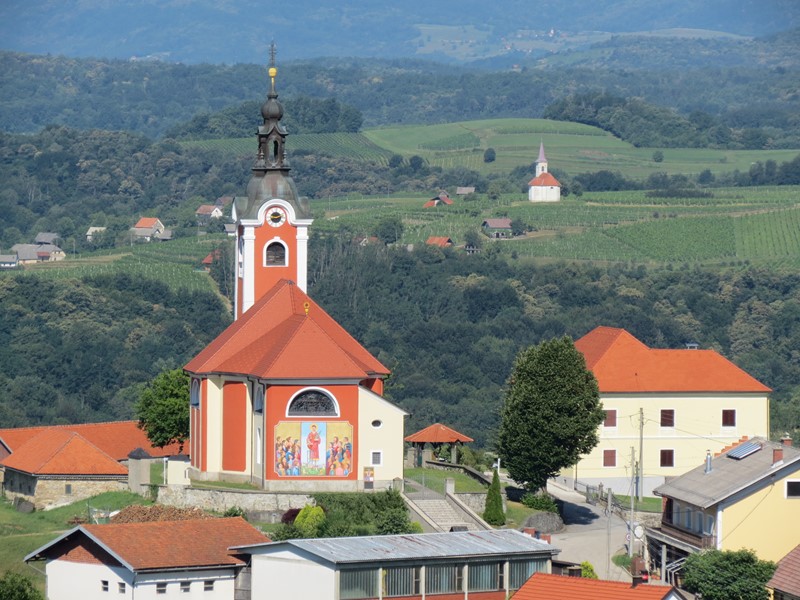
The present parish church of St. Lawrence was built in 1754 and was consecrated on July 12, 1757. The church is a late-Baroque landmark overlooking the surrounding hills and vineyards. The parish continued to celebrate St. Lawrence as its patron, with the traditional parish celebration taking place around August 10.
The church has remained an important gathering place for generations of Vivodina families. Its history is not only the story of a building, but also of the people who worshipped there, raised their families in the surrounding villages, and carried their faith and traditions with them when they left Croatia.
A major restoration of the church, inside and out, took place from 1995 through 2002. The restoration was supported by the faithful of the Vivodina area as well as people who had emigrated overseas. In 2017, the parish celebrated the 260th anniversary of the church's consecration, emphasizing the generations of families who had entrusted the church and its traditions to those who followed them.
From Vivodina to Pennsylvania
During the late 19th century, people from Vivodina and the surrounding villages began leaving their homeland in search of work and opportunity. The movement was part of the larger wave of Croatian emigration to North America during the era of the Austro-Hungarian Empire.
The scale of that movement can be seen in historical population data. A scholarly study using 1890 census material records 476 people from the administrative area of Vivodina in “America”, compared with 68 recorded in Croatia and Slavonia and 30 elsewhere in Austria-Hungary. The figures illustrate how substantial overseas migration had already become by the end of the 19th century.
Pennsylvania became an especially important destination because its rapidly growing industrial towns offered work in steel, railroads, mines and other industries. In Steelton, the Pennsylvania Steel Company had grown enormously by the 1890s; its production and workforce attracted immigrants from many parts of Europe. The Steelton Historical Society records that foreign workers arrived by the hundreds and that several thousand foreign-born residents were living in the borough by the late 19th century.
Vivodina's connection to Steelton is particularly significant. On February 10, 1895, Croatians in Steelton organized the St. Lawrence Society (Društvo Sveti Lovro). Historical genealogical material identifies the society as being named for the patron saint of Vivodina because many of the people who gathered to establish it had emigrated from Vivodina. This connection eventually became the foundation of today's St. Lawrence Club, CFU Lodge #13.
In this way, the story of St. Lawrence in Steelton is closely tied to the story of Vivodina. Families who left the hills of Croatia brought with them their faith, family names, customs, music and devotion to Sveti Lovro. In Pennsylvania, they built a new community while keeping a connection to the place their families had called home.
The name St. Lawrence is more than the name of a club. It is a link between Vivodina and Steelton — between the church where generations worshipped in Croatia and the Croatian-American community that generations of immigrants built in Pennsylvania.
Sources: Archdiocese of Zagreb; Hrvatska enciklopedija; Croatian Catholic Information Agency (IKA); Steelton Historical Society; Acta Croatica; historical demographic research cited above.